Thursday, 26 March 2015

Thursday, 19 March 2015
Christa Mcauliffe
Christa McAuliffe
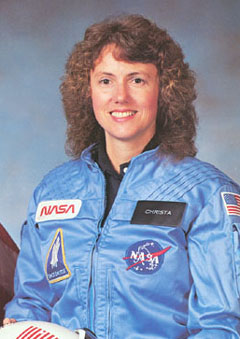 AKA Sharon Christa Corrigan
Born: 2-Sep-1948
Birthplace: Boston, MA
Died: 28-Jan-1986
Location of death: Space Shuttle Challenger
Cause of death: Accident - Misc
Remains: Missing
Gender: Female
Race or Ethnicity: White
Sexual orientation: Straight
Occupation: Astronaut
Nationality: United States
Executive summary: First teacher in space
Christa McAuliffe was selected for the NASA Teacher in Space Project on 19 July 1985. She was to be the first civilian sent into space. NASA hoped that having a civilian on the space shuttle would generate more enthusiasm for the space program on the part of ordinary citizens. A teacher, they believed, would be especially well suited to serve as a pro-NASA spokesperson -- and, of course, who better to inspire the minds of the next generation of astronauts than a school teacher.
Billed by her own students as "inspirational human being, a marvelous teacher who made their lessons come alive", McAuliffe was a high school teacher, selected out of 11,500 applicants. She began training at NASA's Houston facility in September 1985. Concerned about pulling her own weight on the mission, she worked actively during 114 hours of training.
Making the most of her "Teacher in Space" role, McAuliffe was to have taught two lessons from space. In the first she would introduce each crew member to the viewing audience (which included many children), explain their job aboard the shuttle and how they lived, ate, and exercised during the flight. She would also explain a little about the shuttle itself, especially the cockpit with its 1,300 dials and switches. Her second lesson was to explain how the shuttle flew and how human beings benefit from space exploration and the technological advances that it continues to generate.
73 seconds after lift-off, the space shuttle Challenger exploded, killing McAuliffe and the six other crewmembers aboard.
Following the Challenger disaster, numerous funds and awards were created to immortalize McAuliffe's enthusiasm for teaching and for the field of social science. The Christa McAuliffe Planetarium, an ongoing memorial to McAuliffe and her love for hands on learning opened in June 1990 in Concord, New Hampshire. It receives roughly 30,000 visitors per year.
Though her time as an astronaut was short, McAuliffe has been the subject of several books including:Christa McAuliffe, Teacher In Space (Corrinne J. Naden and Rose Blue), Christa McAuliffe, Reaching For The Stars (Patricia Stone Martin), I Touch the Future, The Story of Christa McAuliffe (Robert T. Hohler), and A Journal for Christa: Christa McAuliffe, Teacher in Space written by Grace George Corrigan, Christa McAuliffe's mother.
Mother: Grace George Corrigan
Husband: Steven McAuliffe
Son: Scott Corrigan (b. 11-Sep-1976)
Daughter: Caroline Corrigan (b. 24-Aug-1979)
High School: Marian High School, Framingham, MA (1966)
University: BA History, Framingham State College (1970)
University: MA School Administration, Bowie State College (1978)
Asteroid Namesake 3352 McAuliffe
Is the subject of books:
A Journal For Christa: Christa McAuliffe, Teacher in Space, Sep-1
AKA Sharon Christa CorriganBorn: 2-Sep-1948
Birthplace: Boston, MA
Died: 28-Jan-1986
Location of death: Space Shuttle Challenger
Cause of death: Accident - Misc
Remains: Missing
Gender: Female
Race or Ethnicity: White
Sexual orientation: Straight
Occupation: Astronaut
Nationality: United States
Executive summary: First teacher in space
Christa McAuliffe was selected for the NASA Teacher in Space Project on 19 July 1985. She was to be the first civilian sent into space. NASA hoped that having a civilian on the space shuttle would generate more enthusiasm for the space program on the part of ordinary citizens. A teacher, they believed, would be especially well suited to serve as a pro-NASA spokesperson -- and, of course, who better to inspire the minds of the next generation of astronauts than a school teacher.
Billed by her own students as "inspirational human being, a marvelous teacher who made their lessons come alive", McAuliffe was a high school teacher, selected out of 11,500 applicants. She began training at NASA's Houston facility in September 1985. Concerned about pulling her own weight on the mission, she worked actively during 114 hours of training.
Making the most of her "Teacher in Space" role, McAuliffe was to have taught two lessons from space. In the first she would introduce each crew member to the viewing audience (which included many children), explain their job aboard the shuttle and how they lived, ate, and exercised during the flight. She would also explain a little about the shuttle itself, especially the cockpit with its 1,300 dials and switches. Her second lesson was to explain how the shuttle flew and how human beings benefit from space exploration and the technological advances that it continues to generate.
73 seconds after lift-off, the space shuttle Challenger exploded, killing McAuliffe and the six other crewmembers aboard.
Following the Challenger disaster, numerous funds and awards were created to immortalize McAuliffe's enthusiasm for teaching and for the field of social science. The Christa McAuliffe Planetarium, an ongoing memorial to McAuliffe and her love for hands on learning opened in June 1990 in Concord, New Hampshire. It receives roughly 30,000 visitors per year.
Though her time as an astronaut was short, McAuliffe has been the subject of several books including:Christa McAuliffe, Teacher In Space (Corrinne J. Naden and Rose Blue), Christa McAuliffe, Reaching For The Stars (Patricia Stone Martin), I Touch the Future, The Story of Christa McAuliffe (Robert T. Hohler), and A Journal for Christa: Christa McAuliffe, Teacher in Space written by Grace George Corrigan, Christa McAuliffe's mother.
Mother: Grace George Corrigan
Husband: Steven McAuliffe
Son: Scott Corrigan (b. 11-Sep-1976)
Daughter: Caroline Corrigan (b. 24-Aug-1979)
High School: Marian High School, Framingham, MA (1966)
University: BA History, Framingham State College (1970)
University: MA School Administration, Bowie State College (1978)
Asteroid Namesake 3352 McAuliffe
Is the subject of books:
A Journal For Christa: Christa McAuliffe, Teacher in Space, Sep-1

Hi friends I would share first Toyota car model image and hyperlink


Thursday, 12 March 2015
The First Cellphone Went on Sale 30 Years Ago for $4,000
Ads by Google
Pluralsight Training - Easy Online Developer Courses. Free 10 Day Trial. Sign Up Now!
www.pluralsight.com/Free-Trial
TAFE Courses Australia - Nationally Recognised Courses. Study Anytime, Anywhere
www.seeklearning.com.au/OTEN
Become a Counsellor - Study Your Diploma Course Online. Special Course Fee Offer. Ends Soon
www.opencolleges.edu.au
Pluralsight Training - Easy Online Developer Courses. Free 10 Day Trial. Sign Up Now!
www.pluralsight.com/Free-Trial
TAFE Courses Australia - Nationally Recognised Courses. Study Anytime, Anywhere
www.seeklearning.com.au/OTEN
Become a Counsellor - Study Your Diploma Course Online. Special Course Fee Offer. Ends Soon
www.opencolleges.edu.au

IMAGE: ETHAN MILLER/GETTY IMAGES

Somewhere in either Chicago, Baltimore or Washington, someone plunked down $3,995 to buy the Motorola DynaTAC 8000X, the first handheld cellphone, on March 13, 1984 — 30 years ago today.
We don't know who that first cellphone buyer was. At the time, the occasion didn't register as historically auspicious. After all, in 1984, the terms "cellphone" and "mobile phone" didn't refer to handheld phones; those terms referred to car phones, which had been around since the mid-1940s. What was celebrated at the time was the kick-off consumer cellular call — made to the great-grandson of Alexander Graham Bell — six months earlier.
A handheld portable phone was considered a gimmick, a "look what I got!" rich man's toy with dubious utility.A handheld portable phone was considered a gimmick, a "look what I got!" rich man's toy with dubious utility. Measuring 13 x 1.75 x 3.5 inches and weighing 28 ounces, the 8000X was so big and heavy, even its creators had nicknamed it "The Brick." Plus, you could only use it for a half an hour before the battery gave out. Who would pay a quarter of the average salary in 1984 — more than $9,000 in 2014 dollars — to carry around such a useless load, especially since payphones were everywhere and only cost a dime to use?
The lack of commemoration of that first portable phone sale is understandable. What has turned out to be the most ubiquitous gadget in history started life as a publicity stunt, prompted by panic.

IMAGE: MOTOROLA, INC. LEGACY ARCHIVES COLLECTION
Ma Bell's monopoly
The cellphone may have had one of the longest gestation periods in tech history. A memo outlining the idea of a hexagonal honeycomb of adjoining antenna sites was laid out in a memo by AT&T researcher Douglas H. Ring in December 1947. At that time and until 1983, car phones transceived via a single citywide antenna that, with limited frequencies, kept the number of subscribers low.
In the mid-1960s, AT&T engineers Joel Engel and Richard Frenkiel perfected cellular technology to allow frequency re-use and call hand-off so you wouldn't lose your call as you moved from one cell to another. These advances geometrically increased the number of potential car phone users.
Once cellular was feasible, AT&T, which already controlled all landline telephone service in the U.S., applied to the FCC for a similar monopoly over the new wireless network.
It was this potential cellular monopoly that threw Motorola, who sold two-thirds of all car phones, into a tizzy.
If Ma Bell was awarded a cellular monopoly, cellular phone equipment would be made by her Western Electric subsidiary — and no one else.If Ma Bell was awarded a cellular monopoly, cellular phone equipment would be made by her Western Electric subsidiary — and no one else.
Ruh oh.
Facing corporate oblivion, Motorola executive Marty Cooperhad a brainstorm: Let's prove to the FCC that a cellular monopoly would inhibit hardware innovation. What would Motorola's innovation be? A rival cellular network with a handheld phone at its center.
Cooper told his engineers to drop everything. On Dec. 3, 1972, a dozen or so Motorola engineers began the seemingly impossible task of compacting the components inside a trunk-sized car phone transceiver cabinet and roof antenna array so the whole phone could be held in your hand.
Five hectic months later, on April 3, 1973, Motorola hosted a grandiose event at New York's Hilton Hotel to present two hand-built DynaTAC handheld phones to an enchanted press. Since there was no actual cellular network built yet, these first two DynaTACs were actually fancy 900 MHz cordless phones. (Here are the full details of the complete whirlwind DynaTAC development process.)
Whether or not Motorola's dog-and-pony show actually affected FCC's decision to not award AT&T a cellular monopoly is debatable. Bottom line: AT&T didn't get it.
The DynaTAC development interregnum
Fortunately for Motorola, it took nearly 10 years for the FCC to get its cellular regulatory and licensing act together.
"The first [phones] we made were a research product," recalls Rudy Krolopp, Motorola's legendary design master. "The DynaTAC wasn't designed to be manufactured and mass produced. Plus, the FCC was giving us all kinds of problems, so to design something we could manufacture sucked up 10 years. We were very busy."
The most visible design change was re-arranging the two vertical rows of number buttons on the original DynaTAC to the more familiar three-by-four grid. Inside the phone, primary engineer Don Linder oversaw the development of custom integrated circuits and microprocessors — which were still a new product in the late 1970s — as well as evolving antenna designs to better penetrate buildings and account for height changes during a call, all of which had to comply to ever-changing FCC spectrum specifications.
Krolopp recalls the DynaTAC going through around eight different iterations. "Each time we had a problem and solved it, we had to change the design."
In all, Motorola spent an estimated $100 million to develop the 8000X — with no idea if the public would ever even want one.
The cellular era begins
The FCC gave carriers the final cellular development go-ahead in March 1982. Ameritech, the Chicago-area Baby Bell, was already in the midst of its 18-month AMPS cellular networkconstruction job — 12 antenna sites to service the entire Chicagoland area.
On March 6, 1983, Motorola officially unveiled the DynaTAC 8000X, but it would be seven months before the FCC gave the phone its blessing. On October 12, 1983, Ameritech initiated the first commercial cellular service in the U.S. Service cost $50 a month plus 40 cents a minute from 9 a.m. to 5 p.m., 24 cents a minute off-peak. Two months later, Cellular One launched its Motorola-designed DynaTAC network in Washington, D.C. and Baltimore.

IMAGE: MOTOROLA, INC. LEGACY ARCHIVES COLLECTION
Until the 8000X went on sale, the only cellphones you could buy were car phones, priced at around $2,500.
"We thought sales [of the DynaTAC 8000X] would be modest," admitted Paul Gudonis, Ameritech's VP of marketing and sales and now CEO of medical device maker Myomo. "Our market research on price point indicated buyers would be a select group of entrepreneurs, doctors, real estate agents, construction company owners and large company executives."
Ameritech sold 12,000 cellular phones that first year, around 10% of which were the DynaTAC 8000X. That may not sound like much, but it was more than anyone expected.
he asked 'Is that a cordless phone?' 'Yes,' I said, 'but the antenna is 10 miles away.'he asked 'Is that a cordless phone?' 'Yes,' I said, 'but the antenna is 10 miles away.'"
From Motorola's point-of-view, the 8000X was a runaway success. "We didn't design them for teenagers — well, unless it was a teenager with $4,000," Krolopp chuckles. "But we couldn't build them fast enough. Businesses started taking them on and it became something else, a part of business — not a convenience, but a necessity. We didn't expect those kinds of volumes."
Ironically, what had been the primary cellphone product — car phones — have completely disappeared. They've been replaced by the decedents of the Motorola DynaTAC 8000X, an unlikely device born out of panic.

IMAGE: MOTOROLA, INC. LEGACY ARCHIVES COLLECTION
Tuesday, 10 March 2015
History of Rail in Australia
Australia's first rail systems were mostly built when the country consisted of sparsely settled colonies, before they combined to form a Federation of States in 1901.
Until the middle of the
1800s, people travelled around the colonies of the Australian continent by
horse-drawn transport and by coastal shipping services. From 1854, when the
first steam railway between Melbourne and Port Melbourne started, the railway
system of the various colonies developed rapidly. Initially all track and
rolling stock was imported, although by the 1880s most of the equipment was
being made locally.
 While
the railways were operated initially by private companies, a shortage of
speculation capital resulted in the continued development of the railways being
undertaken by individual colonial governments. The initial purpose of the rail
development was to connect the hinterland with the major export seaports which,
in most cases, were the capital cities.
While
the railways were operated initially by private companies, a shortage of
speculation capital resulted in the continued development of the railways being
undertaken by individual colonial governments. The initial purpose of the rail
development was to connect the hinterland with the major export seaports which,
in most cases, were the capital cities.
Planners gave little
thought to connecting their railways with the other rail systems.
By Federation in 1901, all
States except Western Australia were ‘linked’ by rail and more than 20,000 km
of track had been laid. Sadly, those who envisaged a nation had not
contemplated a national rail network. Three different gauges had been used.
New South Wales adopted the
European standard gauge of 1435 mm, Victoria and South Australia built with the
broad Irish gauge of 1600 mm, and Tasmania, Queensland, Western Australia and
parts of South Australia used the narrow 1067 mm gauge. For many years, the
different gauges handicapped the effective operation of interstate rail
services.
 In
1917, a person wanting to travel from Perth to Brisbane on an east-west
crossing of the continent had to change trains six times.
In
1917, a person wanting to travel from Perth to Brisbane on an east-west
crossing of the continent had to change trains six times.
The independent development
of the State rail systems led to significant incompatibility problems, not only
in relation to gauge but also equipment and operating practices.
This incompatibility of the
State rail systems was brought to a head during World War II when the war
effort required large quantities of goods and personnel to be moved quickly
throughout Australia. But it was not until June 1995 that trains could travel
between Brisbane and Perth, via Sydney, Melbourne and Adelaide on a standard
gauge track.
By 1970 the situation had
improved sufficiently so that a passenger could remain on the same train on a
journey from Perth to Sydney. Three different gauges still exist in Australia,
but the state capitals are now linked by one uniform gauge.
Steam locomotion was used
until the 1950s when diesel-electric locomotives began to take over. Steam
locomotives were completely withdrawn in the 1970s, but tourist trips are still
available on scenic routes in New South Wales, Victoria and Tasmania.
Suburban electric trains
operate in Sydney, Melbourne, Brisbane and Pert
Go www.infrastructure.gov.au for more detail
Sunday, 8 March 2015
Tourist and Historical place in Srilanka
Trincomalle is an Eastern part of Srilanka.It include seven hot water spring wells.The well are square in shape ,3-4 feet deep only.The temperature is vary from one spring to another.The hot water spring is connected with Hindu Culture.of the Tamil in Srilanka.It made by King Ravana around 5000 years BCE.

Friday, 6 March 2015
Hi friends, I would like to share this article with you.This is history of cloth-line .of Australia.
| Hills clothes hoist 1948 rotary clothes line
Lance Hill's clothes hoist became a symbol of Australian home life in the 1950s but Lance Hill did not invent the rotary clothes hoist. Gilbert Toyne patented one in Adelaide in 1926, which was sold in small numbers until the early 1960s.
In 1945 Lance Hill returned to Adelaide from war. His wife complained that her traditional clothesline between two posts (propped up in the middle by a stick) was in the way of the lemon tree. Hill's answer was to design a compact rotary line out of metal tube and wire. He was unemployed and turned his idea into a livelihood. His first batch was made with tubing salvaged from the frame of the underwater boom that had hung under the Sydney Harbour Bridge to catch enemy submarines during World War II. He designed a cast aluminium winding gear to hoist the line up into the breeze - and the Hill's hoist was born ... at just the right time and place to become spectacularly successful. Hills Industries has now expanded and diversified. It has acquired several different companies and produces many different products, eg, clothes lines, ironing boards, wheelbarrows, antennas, CCTV equipment and systems, building and roofing products to name a few. They have manufacturing plants in the UK and New Zealand. Products are sold in Hong Kong, Singapore, Malaysia and SE Asia, and trade links exists with many countries including Scandinavia, Austria, Hawaii, Greece, Papua New Guinea and Burundi in the African continent. Toyne may have invented the rotary hoist, but it was Hill's entrepreneurial flair and the huge boom in house-building after World War II that made his big metal tree for drying clothes into an icon of suburbia.
Who Did It?
Key Organisations Hills Industries : design, manufacture Key People Lance Hill : developer Harold Ling : brother-in-law, developer
Further Reading
What a line! : the story of the people who made the hoist an Australian icon : fifty years of Hills David Harris Hills Printing Services, Melrose Park, SA, 1996. |  | |
|

Thursday, 5 March 2015


Subscribe to:
Posts (Atom)